Technique
Reading the water: seams, drift lines and where fish actually hold
The company is named after this. It is also the one skill that improves a day's fishing more than any fly in the box.
A fish has to eat more than it spends
Everything a trout does is arithmetic. Holding station in current burns energy; eating replaces it. A fish that sits in fast water burns more than the drifting food can repay, and a fish that sits in dead water gets no food delivered at all. So trout position themselves in the narrow strip where slow water runs alongside fast water: they rest in the slow side and eat what the fast side brings past.
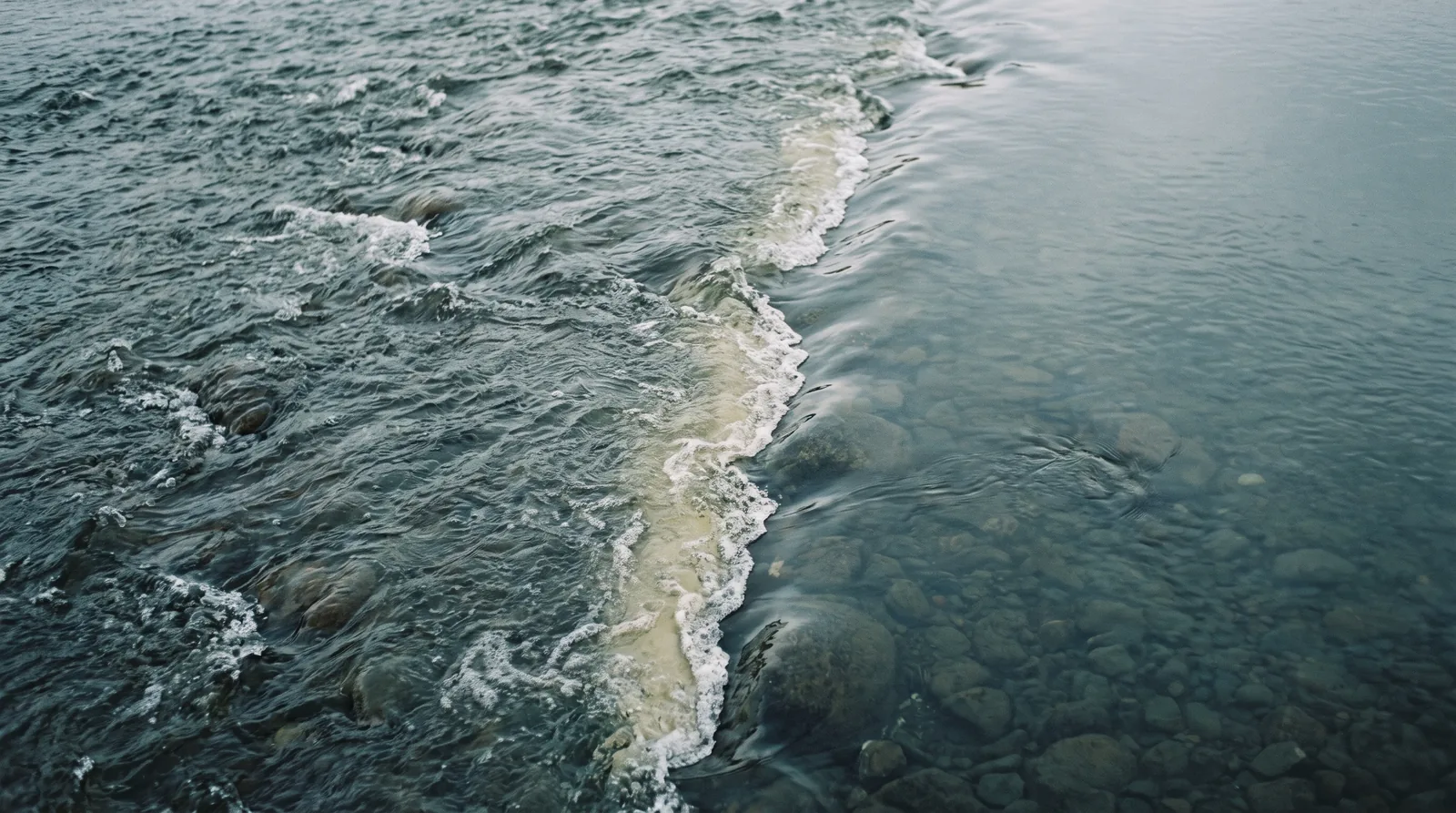
That strip is a seam. On the surface it often shows as a drift line — a thin ribbon of foam, bubbles and bits of leaf tracking downstream. Foam floats where the current converges, and so does food. The old advice is blunt and correct: foam is home.
The five places to look first
Before you tie anything on, spend two minutes finding these. They are in almost every river, and they hold fish far more reliably than open, even-paced water.
- The seam beside the main current — where the tongue of fast water entering a pool rubs against slower water on either side.
- Behind a boulder — the cushion in front of a rock holds fish as often as the pocket behind it, because water piles up and slows there.
- The inside of a bend — the current runs fastest on the outside, so food is swept round and drops out where it slows on the inside.
- The head and tail of a pool — the head oxygenates and delivers, the tail concentrates everything into a narrowing throat before the next riffle.
- Any hard edge — an undercut bank, a weed bed, a fallen tree, a shadow line. Edges give cover on one side and delivery on the other.
Fish the seam, not the middle
Most people cast to the middle of the river because it is the easiest thing to see. The middle is usually the least productive water in front of you. Put the fly on the slow side of the seam and let it drift down the line.
Work close water before far water. Fish hold within a rod length of the bank far more often than anglers expect, and wading straight past them to reach the middle is the most common way to spoil a pool before you have started.
Drag is what gives you away
Because the fast side pulls your line faster than the slow side carries your fly, the line bellies downstream and drags the fly across the current. Nothing on a river looks less like food than an insect swimming sideways at speed. This is why a good drift beats a good fly, every time.
The fix is slack, placed deliberately. Cast slightly upstream of the fish, throw an upstream mend as the line lands, and follow the drift with the rod tip. If the fly is dragging, you are not fishing — you are trailing something across the fish's window.
Mentioned above